in Cyber Security
 Careers
 FAQs
FAQs







Executive Summary: The Accelerated Mandate for AI Governance
This analysis provides a comprehensive, phased strategy for implementing a Federal Government aligned AI adoption program leveraging the Ionize GRC Maturity Model (IGMM). The IGMM is positioned as a strategic roadmap for newly appointed Chief AI Officers (CAIO) to transition their agency’s Governance, Risk and Compliance (GRC) posture from a fragmented, manual state to an integrated, predictive model. This transformation is deemed essential due to the unprecedented velocity of new Federal Government policy mandates, which render traditional GRC practices obsolete.
The Federal Government GRC Paradox and the AI Catalyst
Many federal government agencies’ GRC environments are often characterised by a fundamental disconnect between stated policy intent and observable operational maturity. The introduction of AI serves as a catalyst, accelerating existing risks and mandating immediate, structural GRC reform across the public sector.
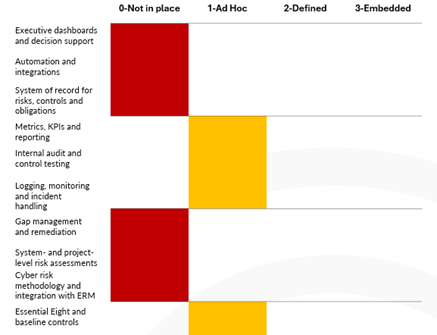
The situation is characterised by a notable “paradox of preparation.” Federal Government entities demonstrate a high degree of preparedness in policy documentation. 82% of Government Departments have a cybersecurity strategy and 90% possess an Incident Response Plan (IRP).[1] This compliance with IGMM Level 2 activities suggests a strong foundational effort. However, this preparatory work is severely undermined by lagging execution, evidenced by an average APS-wide data maturity score of only 2.02 out of 5, categorised as ‘developing’.[2] This disparity reveals that policy exists, but it is not consistently or effectively operationalised across the enterprise.
This fragmented governance is incapable of handling the pace of regulatory change, resulting in pervasive compliance regression. The decline in Essential Eight (E8) attainment is a clear quantitative measure of this failure: only 22% of Commonwealth entities achieved Maturity Level 2 in 2025, a slight increase from 15% in 2024.1 This demonstrates the inability of “manual, document-based processes” to adapt to evolving E8 requirements and mandatory uplift. AI adoption, with its inherent requirement for rapid iteration and high data quality, is incompatible with a static, ad-hoc GRC model. The absence of E8 maturity confirms that the Federal Government’s structural problem is its reliance on manual GRC processes, establishing the business case for GRC automation as a prerequisite for successful AI adoption, rather than as a mere efficiency gain.
[1] The Commonwealth Cyber Security Posture in 2025
[2] Australian Public Service Data Maturity Report 2024
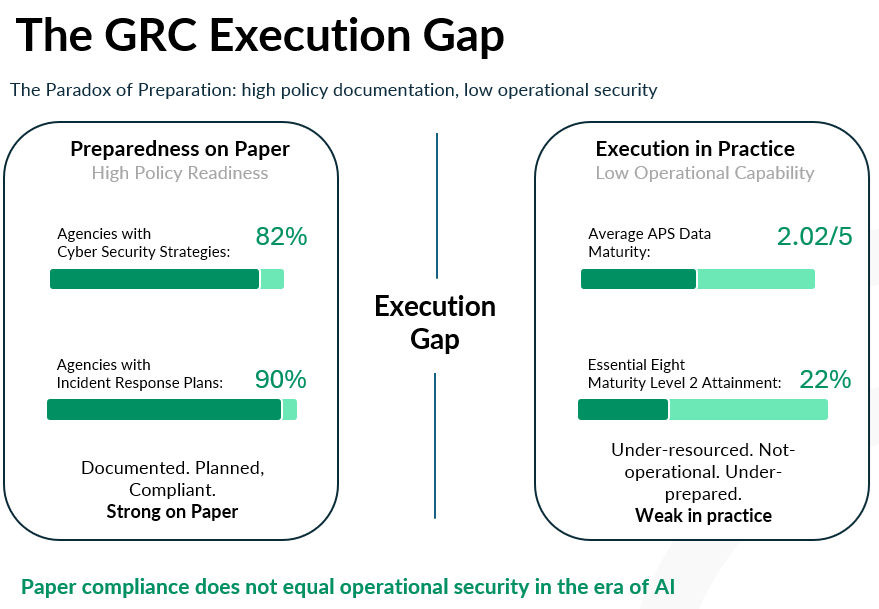
Figure 1-The GRC Execution Gap
Additionally, a significant governance versus execution gap is apparent. While incident response documentation is high, incident reporting to the Australian Signals Directorate (ASD) remains low, with only 35% of entities reporting at least half of the incidents they observe.1 This disparity confirms a cultural and operational disconnect. The CAIO’s AI adoption program must explicitly address this execution gap, ensuring that AI Governance is actively enforced and continuously verified, rather than existing solely as policy documentation.
The Role of the Chief AI Officer (CAIO) as GRC Champion
The strategic mandate of the CAIO requires a wholesale cultural and organisational transformation across the public service.[1] The IGMM provides the operational playbook necessary to realise this transition.
The CAIO’s explicit mandate includes developing the Strategic Vision, overseeing Governance, Ethics, and Risk Management, and driving organisational change management.3 This executive appointment provides the necessary Level 1 leadership commitment required to overcome the historical fragmentation identified in Federal Government GRC. The CAIO acts as the executive GRC champion, accountable for integrating policy, risk, and compliance into a unified program. The fact that the APS AI Plan is led by the Department of Finance [2] further signals that AI governance is fundamentally a fiscal and strategic matter, requiring accountability at the highest levels of the public service.
The strategic imperative for AI is bounded by sovereign and scalable innovation. The CAIO is mandated to transition the agency from ad-hoc pilots to scalable, sustainable innovation, often utilising secure, sovereign platforms like GovAI Chat, which meet the highest standards of Protective Security Policy Framework (PSPF) compliance. This reinforces the necessity of building the AI program on Level 2 (documented sovereign controls) and Level 5 (an integrated platform capable of continuous assurance).
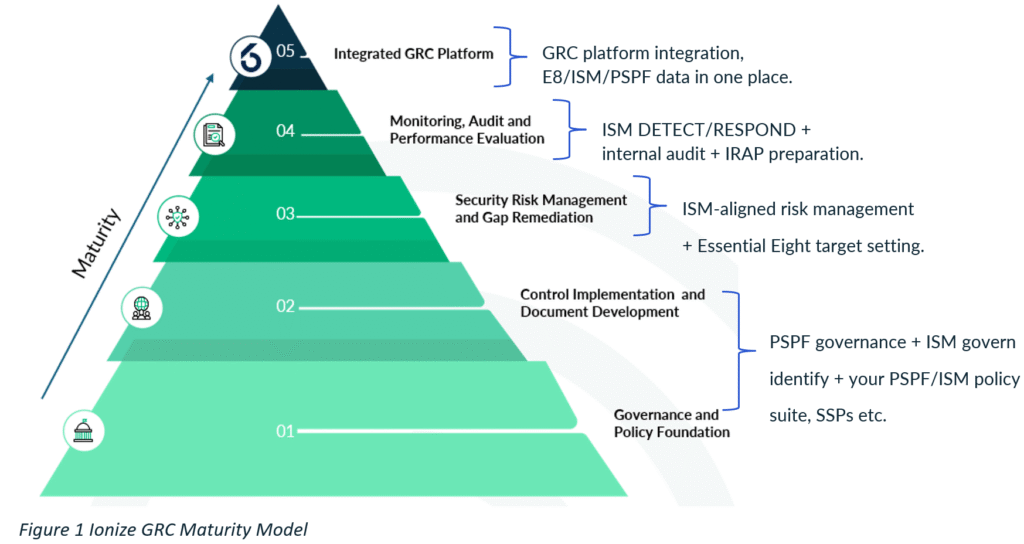
Introducing the Ionize GRC Maturity Model (IGMM) for AI Governance
The IGMM is the structural vehicle required for this transformation, ensuring that security, ethics, and assurance are built-in and auditable throughout the entire AI lifecycle.
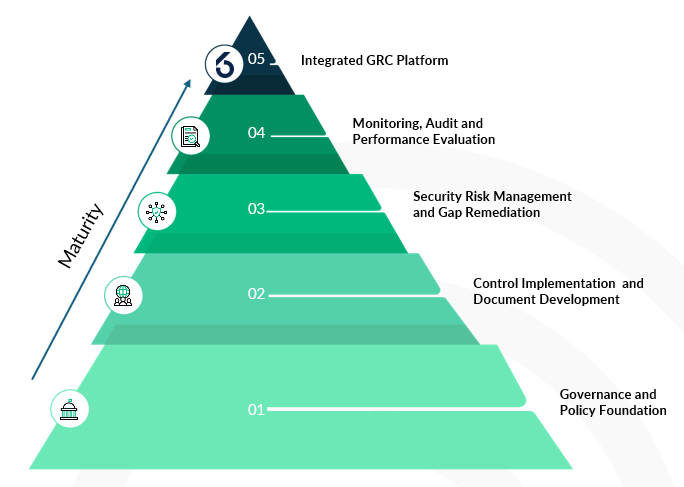
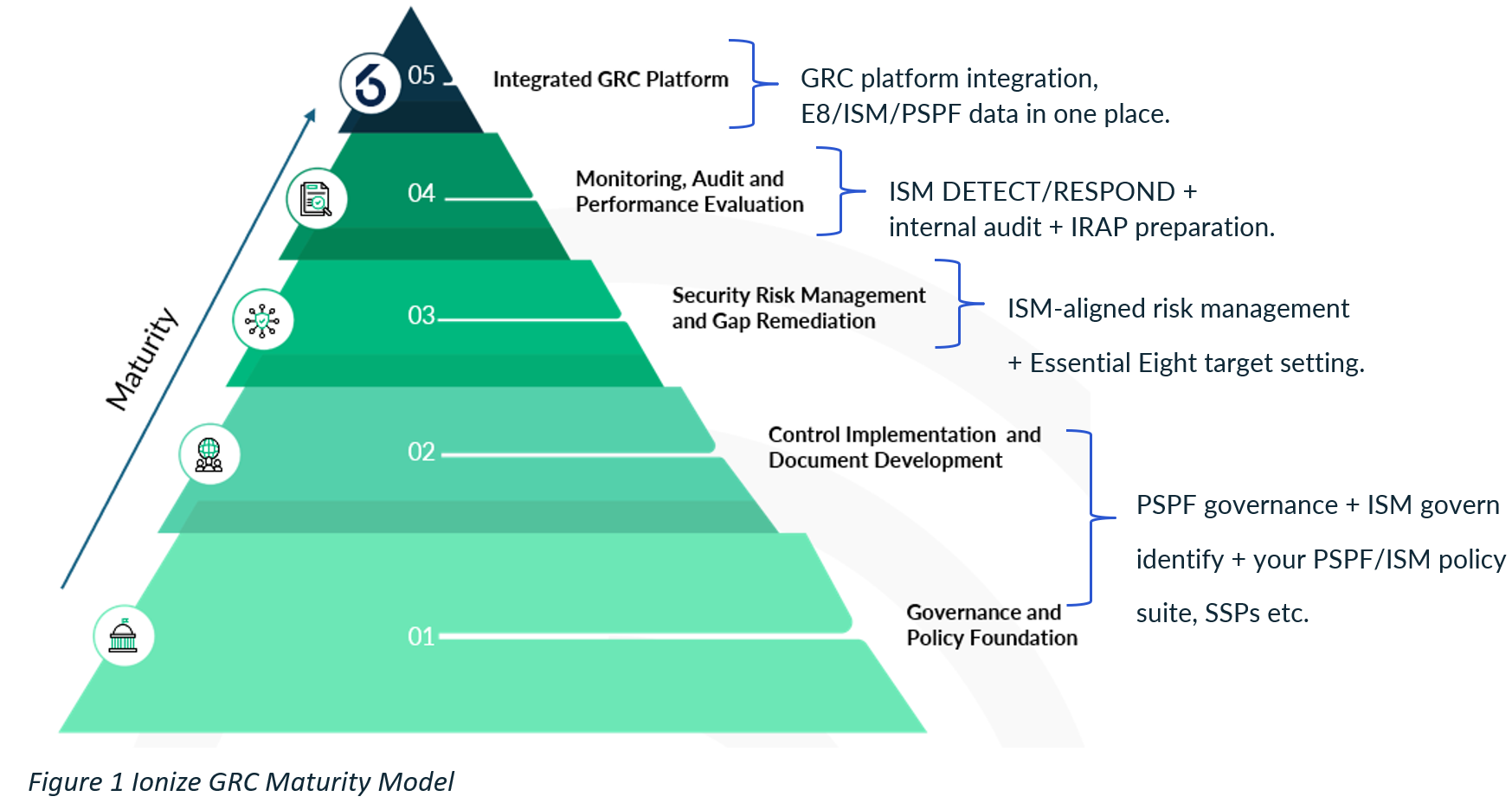
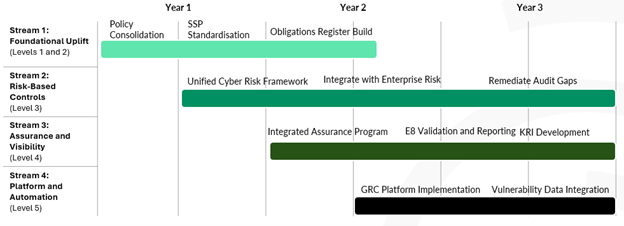
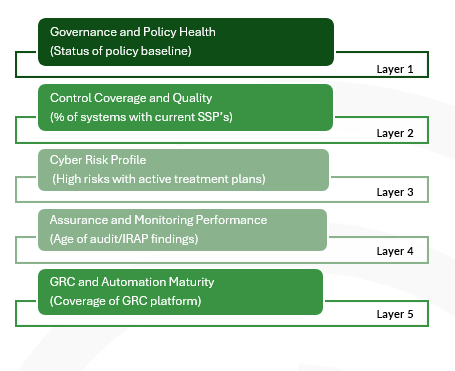
The IGMM is a five-level, prescriptive roadmap that defines the necessary stages of maturity:
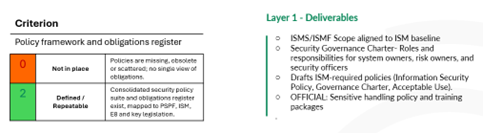
- Level 1: Governance and Policy Foundation: Focuses on leadership commitment, ethical framework establishment, and policy definition.
- Level 2: Control Implementation and Document Development: Aims for system documentation, security rules, and audit-ready artifacts.
- Level 3: Security Risk Management and Gap Remediation: Transitions to quantified risk, requiring AI Risk Assessments (AIRA) and Model Risk Management.
- Level 4: Monitoring, Audit and Performance Evaluation: Concentrates on continuous assurance, performance metrics (KPIs), and executive reporting.
- Level 5: Integrated GRC Platform: The pinnacle of maturity, enabling automation, cross-framework mapping, and predictive governance.
The core IGMM function ensures that the complex, interrelated requirements of AI governance (security, ethics, privacy) are standardised and traceable, enabling the agency to move toward a continuous, predictive state.
[1] Chief AI Officers – Information Pack
[2] AI Plan for the Australian Public Service

Figure 2 Ionize GRC Maturity Model
The following table illustrates how the CAIO’s core mandates map directly to the strategic function delivered by each IGMM level, providing clear accountability and measurable outputs.
Table 1: CAIO Core Mandates Mapped to GRC Maturity Levels
|
CAIO Responsibility |
IGMM Level | Strategic Function |
Core GRC Output / Artifact |
| Strategic Vision and Roadmap | Level 1 (Governance) | Define Purpose, Scope, and Ethics | AI Governance Charter and Policy |
| Technology Architecture Oversight | Level 2 (Controls) | Secure Design and PSPF Alignment | AI System Security Plan (AI-SSP) |
| Risk Management and Assurance | Level 3 (Risk Mgmt), Level 4 (Monitoring) | Quantify and Treat AI Risk | AI Risk Assessment (AIRA) and Model Risk Management Plan |
| Talent Development and Change | Level 1 and 2 (Policy/Controls) | Awareness, Ethical Use, and Skill Uplift | AI Acceptable Use Policy and Training Program |
IGMM Level 1 – The Strategic Alignment: The CAIO Mandate and the Governance Foundation
IGMM Level 1 Objective: Establish the definitive mandate for responsible AI adoption, secure structural risk ownership at the executive level, and to formally integrate the ethical governance framework.
- Mandating Structural Risk Ownership: The CAIO must provide the definitive “Leadership Commitment and Role Clarity” necessary for AI governance to succeed. Level 1 is where GRC activities begin, moving the focus from organisational silos to unified governance structures.
- Formalising the AI Governance Charter (AGC): The AGC serves as the foundational document, defining the Information Security Management System (ISMS) scope for all AI systems and establishing the legal, regulatory, and ethical context. This charter must formally integrate the Australian Public Service (APS) AI Plan 20254 pillars including Trust, People, and Tools into the agency’s ISMS objectives. This process ensures the CAIO’s strategic vision is documented and aligned with organisational objectives.
- Executive Accountability: The Governance Committee Charter must mandate that AI risk is explicitly treated as an enterprise risk, ensuring that structural risk ownership is assigned to senior executives. This commitment fulfills a foundational principle of the PSPF. The critical implication is that AI Governance cannot be siloed within IT. Without this top-down commitment, subsequent levels of control implementation (Level 2) and monitoring (Level 4) will invariably fail due to a lack of resources and conflicting priorities.
Codifying the Australian AI Ethics Principles Framework:
Level 1 governance must ensure that ethical compliance is formalised and auditable. The CAIO must translate the national AI Ethics Principles[1]into the agency’s formal policy structure.
[1] Australia’s AI Ethics Principles | Department of Industry Science and Resources
- Core Principles Adoption: The AI Ethics Policy must formally adopt the fundamental principles, including Community Benefit, Fairness, Privacy and Security, Transparency, and Accountability. For example, compliance with the Privacy and Security principle requires ensuring “the protection of data” and upholding “privacy rights of individuals” throughout the AI system lifecycle.
- Mandatory Linkage to Risk: The governance structure must mandate that ethical compliance is traceable and auditable. For instance, the principle of Fairness dictates the need for policies ensuring that the data model is designed with a focus on diversity and inclusion, and that the dataset used is representative for the problem solved. This Level 1 commitment establishes the basis for specific control requirements later in the maturity journey (Level 2 data quality procedures) and dictates the scope of Level 3 risk assessments (Bias Audits).
[1] Australia’s AI Ethics Principles | Department of Industry Science and Resources
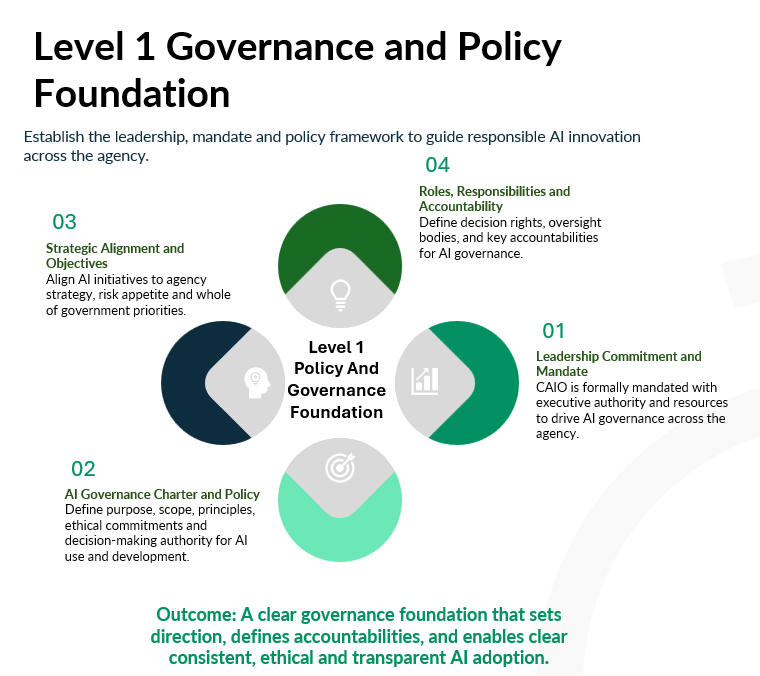
Figure 3 – Level 1 Governance
Foundational Governance Artifacts (Level 1 Outputs)
The successful completion of Level 1 yields the foundational governance artifacts that direct all downstream GRC activities:
- AI Governance Charter (AGC): A formal document defining the purpose, objectives, scope, and leadership commitment for all AI use within the agency.
- AI Ethics Policy: Codifies the Australian AI Ethics Principles, emphasising rules such as mandatory Human Oversight and prohibitions against non-discrimination.
- AI Use Case Register: A centralised inventory of all AI systems and their respective owners, boundaries, and intended outcomes, supporting the required transparency and future auditability by the CAIO’s office.
IGMM Level 2 – The Foundational Framework: Documenting the Secure AI Ecosystem
IGMM Level 2 Objective: Converts Level 1 strategic intent into key, accreditation ready documentation (System Security Plan, Statement of Applicability, Incident Response Plan, Standard Operating Procedures) and mandatory baseline controls, creating the necessary “Audit Evidence Foundation” for the AI program.
- Documenting System Security: The AI System Security Plan (AI-SSP). The AI-SSP is the primary system-level assurance artifact required for Information Security Manual (ISM) compliance, detailing the system architecture, accreditation boundaries, and specific implemented controls.
- Sovereign Design and PSPF Compliance: The AI-SSP must explicitly address the PSPF requirements for Generative AI use with OFFICIAL information. This is critical for maintaining public trust and national security assurance. Specifically:
- Hosting Certification: The AI-SSP must confirm that the AI solution utilised (e.g., GovAI Chat or external Large Language Model (LLM)) is either hosted on a Certified Service Provider (CSP) under the Hosting Certification Framework (e.g., Microsoft Azure, AWS, Google) or has undergone a Foreign Ownership, Control, or Influence (FOCI) risk assessment.
- Technology Authorisation: It must document adherence to PSPF Requirements 0086, 0087, and 0088 for technology authorisation processes.
- AI-Specific Control Implementation: The AI-SSP must incorporate controls related to managing the dynamic nature of AI systems. This involves addressing the risks of model drift and prompt injection. The plan must detail controls covering the full data lifecycle, from data classification upon ingestion to secure deletion.
Operationalising Ethical and Security Controls: AI Adoption Rules
Level 2 requires clear operational procedures (SOPs) that staff can follow consistently, which directly counteracts the “siloed and ad hoc” methodology that inevitably lead to governance failures.
AI Acceptable Use Policy (AI-AUP): This critical artifact formalises controls around data input and output handling.
- Data Handling Constraint: The policy must strictly prohibit the input of sensitive, confidential, or client data into unapproved (public) LLMs and mandate the use of only enterprise solutions (e.g., ChatGPT Enterprise, Azure OpenAI) with contractual guarantees of data privacy and non-training.
- Transparency and Disclosure: Level 2 procedures must require that clients be informed when AI has contributed substantially to deliverables, fulfilling the Level 1 principle of Transparency.
IGMM Insight: Proof of Control: Level 2 establishes the audit evidence foundation. For AI, this means integrating technical enforcement mechanisms into documentation, e.g. such as mandating Single Sign-On (SSO) via Entra ID with Multi-Factor Authentication (MFA) and requiring detailed audit log integration with a solution like Microsoft Purview or Castlepoint[1]. This ensures that all AI usage is recorded, auditable, and traceable, providing the necessary evidence for ISM compliance verification (Level 4).
[1] Castlepoint – The Smarter Way to Manage Information & Risk with Ethical AI
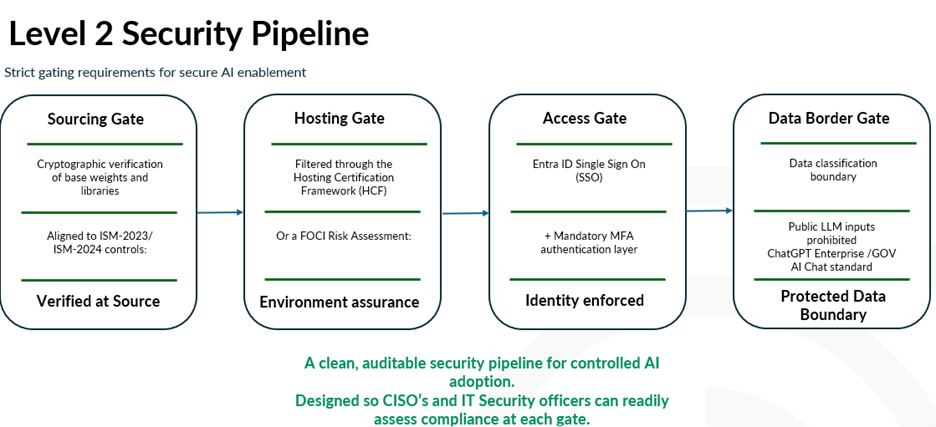
Figure 4 – Level 2 Security Pipeline
Foundational Control Artifacts (Level 2 Outputs)
The following key outputs formalise the control baseline:
- AI System Security Plan (AI-SSP): The detailed system description, boundary, and control implementation narrative, aligned with ISM and PSPF requirements.
- AI Statement of Applicability (AI-SoA): A list of applicable security controls (derived from the ISM), justifying inclusion and referencing the implementation evidence required by auditors.
- AI Adoption Rules / Policy (AUP): Detailed operational procedures (SOPs) covering secure data handling, Prompt Engineering Prevention, and mandated Human Oversight for critical outputs.
IGMM Level 3 – Risk-Driven Prioritisation: Mitigating AI-Related Civil Liability
IGMM Level 3 Objective: Transitions the AI program from mere documentation to quantified, risk-driven governance, assessing and treating AI specific threat vectors and the new reality of legal liabilities. This is the level where policy commitments are validated against real-world risk.
- Risk Quantification: Level 3 mandates that the risk assessment methodology must be updated to incorporate the financial and legal liability risks applicable to AI adoption including qualitative risk assessments.
- Privacy Act Statutory Tort: The introduction of a statutory tort for ‘serious invasions of privacy’ transitions data governance failure from a regulatory fine risk to a direct civil litigation risk.
- Linking Data Maturity to Financial Exposure: The APS’s low average data maturity score (2.02/5) indicates pervasive risks in data quality, security, and integrity. Level 3 must now quantify the financial liability of deploying AI systems that rely on this ‘developing’ quality data, possibly indicating a requirement for “catastrophic risk quantification’. The lack of reliable data governance (a Level 1/2 failure) directly compounds the financial risk realised at Level 3.
- Strategic Prioritisation: The Security Risk Management Plan (SRMP) must prioritise AI remediation projects based on this newly quantified financial and legal liability exposure. This ensures that resource investments are strategically directed to address underlying data governance gaps where the legal exposure is highest focusing remediation efforts where they mitigate the most significant business impact.
The AI Risk Assessment (AIRA) and Model Risk Management Plan (MRMP)
AI systems introduce unique security and ethical risks (e.g., model drift, bias) that require specialised Level 3 artifacts, aligning with the principles of ISO 42001 (AI Management Systems).
AI Risk Assessment (AIRA): This assessment identifies and quantifies AI specific risks, utilising a tailored methodology embedded in the agency’s risk management framework. Key risk vectors assessed include:
- Accuracy/Reliability/Hallucination: The risk of the model generating fabricated statements or inaccurate advice possibly resulting in bad decisions or financial loss.
- Sensitive Data Leakage/Privacy: Risk vectors such as the unintentional upload of client data, PII/Protected data leakage or risks related to cross border data residency.
- Bias/Discrimination/Unfair Output: Models producing exclusionary or skewed language, failure to represent certain groups which violates the Level 1 Fairness principle.
Model Risk Management Plan (MRMP)[1]: This dedicated plan governs the AI model lifecycle, ensuring trustworthiness and resilience, particularly relevant for critical infrastructure integration (ACSC/CISA guidance).
- Validation and Testing: The MRMP mandates the inclusion of formal procedures for Baseline Benchmark Tests (pre-deployment validation), Retrieval Augmented Grounding (RAG) checks (quarterly citation accuracy checks), and Version Change Regression (to manage model drift following updates).
- Bias and Fairness Audit: This plan requires periodic (e.g., semi-annual) bias testing to validate compliance with the ethical mandate established in Level 1.
[1] AI Risk Management Framework | NIST

Figure 5 – Level 3 Risk Quadrant
Risk Management Artifacts (Level 3 Outputs)
- AI Risk Register (AIRA): The central log of identified, assessed, and quantified AI risks, with likelihood and impact scored based on the agency’s risk criteria.
- Security Risk Management Plan (SRMP): Details the defined treatment options (Reduce, Avoid, Accept, Transfer) and remediation timelines for unacceptable risks identified in the AIRA.
- Model Risk Management Plan (MRMP): The governance document detailing model validation, performance metrics, monitoring, and rigorous change management protocols across the model lifecycle.
IGMM Level 4 – Audit and Performance Evaluation
IGMM Level 4 Objective: Focus on monitoring the effectiveness of controls and governance through a rigorous schedule of internal and external audits to measure security program performance and drive continuous improvement.
Establishing the Audit Cycle and Verification Trails
Level 4 represents the stage where an agency moves beyond static documentation to active oversight through formal audit cycles. The CAIO must oversee an audit program that validates the implementation of AI controls established in Level 2.
Internal and External Audits: This level is where formal audits occur to measure the actual performance of the security program against stated goals. These audits must verify that the AI system operates within the boundaries defined in the AI-SSP and adheres to the ethical standards set at Level 1. The result of these audits provides the CAIO with the audit evidence foundation needed for external certifications and regulatory reviews.
Performance Metrics: To support the audit process, Level 4 involves establishing Key Performance Indicators (KPIs) and performance metrics. For AI governance, this includes auditing the accuracy of model outputs, tracking hallucination rates, and verifying the effectiveness of human-in-the-loop oversight.
Integrity Assurance and Algorithmic Accountability
Level 4 outputs are critical for defending against potential allegations of negligence or misconduct, particularly in relation to large government programs incorporating AI. Level 4 must generate robust, verifiable evidence through audit reports and management review minutes. This demonstrates that the CAIO’s office is actively identifying deficiencies and implementing corrective actions.
Algorithmic Auditing: Level 4 audits must specifically assess the AI system’s ability to generate explainable outputs and demonstrate compliance with future transparency obligations. The deployment of AI cannot be a “black box” deployment. If an audit cannot verify the logic behind an AI-driven decision, the system may be deemed a compliance liability.
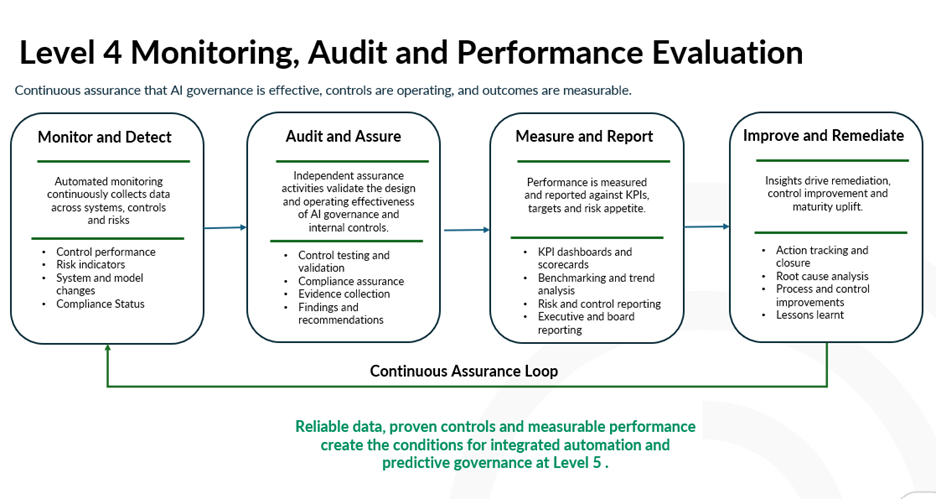
Figure 6 – Level 4 Monitoring, Audit and Performance Cycle
Monitoring and Audit Artifacts (Level 4 Outputs)
- Internal AI Audit Reports: Formal assessments against the AI-SSP and ethical principles.
- ISMS KPI Dashboard: Metrics driven visibility into control performance and audit status.
- Corrective Action Register: A central log tracking the remediation of issues identified during audits.
- Management Review Records: Documentation of executive decisions made based on audit findings.
IGMM Level 5 – The Pinnacle of Maturity: Integrated AI GRC Platform
IGMM Level 5 Objective: This level involves full spectrum, continuous, predictive AI governance by deploying an integrated GRC platform.
Enterprise GRC as the Essential Technical Foundation
Level 5 represents a fundamental shift in Federal Government GRC, moving away from outdated manual practices that often stifle strategic progress. By adopting a sovereign, purpose built GRC platform, agencies can unify fragmented compliance requirements such as the PSPF, ISM, E8, and DISP into a single, reliable source of truth. This modern architecture replaces crisis driven manual tasks with automated workflows and continuous control monitoring, turning governance into a scalable and repeatable business process.
Automation of the AI Governance Lifecycle
Within the AI governance lifecycle, Level 5 transforms the manual efforts of earlier stages into near real-time automated processes. The platform handles the maintenance of governance artifacts by leveraging machine learning features to automatically map internal controls to shifting regulatory landscapes, such as ISO 42001 or revised PSPF guidance. Additionally, workflow driven assurance ensures that Privacy Impact Assessments and AI Risk Assessments are triggered automatically by any system changes, while the integration of Model Validation Record results allows for executive oversight of model accuracy, drift, and bias. This enables the CAIO to manage model integrity and ethical performance across the entire AI environment in real time, providing direct evidence for management reviews.
Strategic Alignment: Predictive and Integrated Assurance
This evolution shifts the role of security from a necessary cost burden to a powerful strategic enabler. Through predictive governance, centralised data is analysed to identify risk patterns before they escalate into crises, allowing for proactive remediation and smarter investment decisions. Ultimately, integrated assurance provides a holistic view of the AI environment, ensuring that every system simultaneously satisfies security, privacy, and ethical obligations. This unified approach strengthens risk resilience and ensures that AI initiatives remain aligned with broader strategic goals.

Figure 7 – Level 5 Continuous Assurance Cycle
Conclusion: Navigating Accelerated Regulatory Complexity
The Ionize GRC Maturity Model offers the Australian Federal Government a structured, prescriptive roadmap to successfully navigate the accelerated complexity and heightened liability associated with AI adoption. The strategic mandate of the Chief AI Officer (CAIO) cannot be fulfilled by inheriting the APS’s “developing” GRC maturity or relying on the manual, siloed processes that directly contributed to the E8 regression. The IGMM provides the necessary phased transformation, ensuring that security and ethics are not afterthoughts but integrated principles throughout the AI program lifecycle.
The progression through the levels of the IGMM systematically addresses the critical deficiencies identified within the Commonwealth:
- Level 1 ensures that executive commitment and an auditable ethical framework are established, solving the governance paradox.
- Level 2 mandates the creation of PSPF-aligned, sovereign security documentation (AI-SSP), establishing the necessary evidence foundation.
- Level 3 enforces a risk-driven approach, quantifying AI exposure against the new Privacy Act civil liability and prioritising investments based on financial exposure.
- Level 4 shifts the agency to a continuous assurance model building the robust, verifiable audit trail required to defend against possible operational failures.
- Level 5 provides the essential technical solution. An integrated GRC platform capable of delivering the cross-framework mapping and operational velocity required to achieve resilient, predictive governance at scale.
By adopting this model, Federal Government agencies can transition GRC from a passive compliance overhead to an integrated, strategic capability that ensures responsible AI deployment and enables resilient public service innovation. The IGMM provides the verifiable audit trail and continuous assurance required for both operational integrity and sovereign security.
The transformation of an ad-hoc AI adoption strategy into a principled, scalable capability requires a methodical, layered approach that directly addresses the unique ethical, security, and governance risks inherent in artificial intelligence. The IGMM serves as the definitive prescriptive roadmap for this journey, translating strategic intent into measurable, auditable outputs at every stage.
The following table details the key artifacts and deliverables required at each level of the maturity model to support the development and sustainment of an AI adoption program, ensuring alignment with the Australian Federal Government’s mandates and the vision of the Chief AI Officer.
Table 2: IGMM Levels Mapped to Federal Government Requirements
|
IGMM Level |
Level Objective | Primary Outputs (Artifacts and Documentation) |
AI Governance and FEDERAL GOVERNMENT Alignment |
| Level 1: Governance and Policy Foundation | Establish executive commitment, define accountability (CAIO), and formally integrate the ethical and legal framework for AI use. | AI Governance Charter (AGC) | Formal AI Ethics Policy (codifying principles of Fairness, Transparency, Accountability) | AI Acceptable Use Policy (AI-AUP) | CAIO/Executive Accountability Matrix (RACI) | ISMS Scope Extension Document (to include AI systems and data pipelines) | Staff Training – AI Fundamentals[1] | Executive Mandate: Defines CAIO ownership and aligns policy with the APS AI Plan ‘Trust’ pillar. Legal: Formalises compliance with the Australian AI Ethics Principles. |
| Level 2: Control Implementation and Document Development | Convert policy into system-level, accreditation-ready documentation and implement sovereign control baselines for AI platforms and data handling. | AI System Security Plan (AI-SSP) (detailing security design, PSPF compliance, and GovAI requirements) | Model Risk Management Plan (MRMP) (initial scope) | AI-Specific Standard Operating Procedures (SOPs) (e.g., prompt handling, IP protection, data quality checks) | AI Workforce Training Content (aligned with APS AI Plan ‘People’ pillar) | Control Implementation Tracker (documenting sovereign hosting status) | Accreditation Readiness: Provides audit evidence foundation (ISM/IRAP) and documents compliance with PSPF technology authorization requirements.
Operations: Establishes repeatable processes for safe AI interaction. |
| Level 3: Security Risk Management and Gap Remediation | Transition from policy documentation to quantified, risk-driven governance by identifying, assessing, and treating AI-specific risks and control gaps. | AI Risk Assessment (AIRA) (quantifying risks such as model bias, data leakage, and hallucination) | AI Risk Register (integrating model risk and ethical impact into the enterprise register) | Risk Treatment Plan (POAandM) for AI control deficiencies | Privacy Impact Assessment (PIA) Template for AI Systems | Supplier Risk Assessment (for external AI service providers) | Risk-Driven: Ensures strategic prioritization of resources based on measured liability, shifting focus from compliance to proactive risk reduction. Assurance: Establishes the necessity for continuous performance validation against model drift (ACSC/CISA guidance). |
| Level 4: Monitoring, Audit and Performance Evaluation | Measure the effectiveness of AI controls and governance, conduct formal assurance, and generate verifiable evidence to maintain continuous compliance and demonstrate oversight. | AI Performance KPI/Metric Dashboard (tracking model accuracy, bias metrics, and AI incident MTTR) | Internal AI Audit Reports (assessing compliance against AI-AUP and MRMP) | Corrective Action Register (tracking and verifying AI risk remediation) | Management Review Records (evidence of executive oversight on AI risk posture) | Continuous Monitoring Plan (for model drift and integrity checks) | Continuous Assurance: Enables the agency to prove control effectiveness to regulators and demonstrate continuous governance (Clause 9 of ISO 27001). Accountability: Provides leadership with data-driven insight for performance evaluation and continual improvement. |
| Level 5: Integrated GRC Platform | Achieve strategic, predictive governance by automating workflows, centralising AI-related assurance data, and enabling real-time executive visibility. | Fully Integrated GRC Platform (e.g., 6clicks) configured as a single source of truth | Real-time AI Risk Dashboard (for CAIO/executive reporting) | Automated Cross-Framework Mapping (linking AI risks to ISM, PSPF, and ethical obligations) | Automated Workflow Rules (for AI policy lifecycle management, risk assessment triggers) | AI Risk Intelligence Feeds (for predictive threat modelling) | Optimisation: Overcomes manual GRC processes, supporting scalable adoption and enabling the organization to move toward a predictive, resilient state.
Strategic Alignment: Ensures GRC is embedded into business decision-making, fulfilling the highest requirement of strategic value. |
[1] Guidance for staff training on AI | digital.gov.au
[1] Guidance for staff training on AI | digital.gov.au
Whole-of-Government AI Policy Mapping Blueprint
As the Australian Public Service (APS) accelerates its adoption of artificial intelligence, navigating the intersection of emerging regulatory mandates and existing security frameworks presents a complex operational challenge. The following table provides an implementation blueprint by mapping the core policy outcomes of the Digital Transformation Agency (DTA) Policy for the Responsible Use of AI in Government[1] and the Voluntary AI Safety Standard’s 10 Guardrails[2] directly to the Ionize GRC Maturity Model. By anchoring these separate compliance directives within the five structured levels of the IGMM framework, agencies can systematically transition from initial accountability to an automated, predictive governance posture. This mapping ensures that compliance is not treated as a static, bureaucratic check-box exercise, but is instead engineered directly into the agency’s continuous assurance lifecycles, establishing an accreditation-ready posture aligned with the Protective Security Policy Framework (PSPF) and the Australian Information Security Manual (ISM).
[1] Policy for the responsible use of AI in government – Version 2.0 | digital.gov.au
[2] The 10 guardrails | | Department of Industry Science and Resources
Table 3: Federal Government Frameworks Mapped to IGMM Levels
| IGMM Level | Ethical and Strategic Alignment (DTA / DISR) | Operational Security Mandates (PSPF) | Technical Cyber Security Controls (ISM) | Key GRC Deliverable / Artifact |
| Level 1: Strategic Alignment and Governance | Accountable Official Appointment: Designate a senior executive (e.g., CAIO) legally responsible for AI policy compliance.
Mandatory AI Training: Roll out entry-level AI literacy programs (APSC AI Fundamentals). (Guardrails 1, 2) |
Requirement 1 and Policy Advisory 001-2025: Operationalise executive-led governance for innovative tech. Staff training must explicitly define strict limits on inputting OFFICIAL data into unvetted tools. | Principle P1: Strategic risk management. Broad AI security risks and system integration choices must be formally accepted by the agency’s designated Authorising Officer (AO). | AI Governance Charter and Executive AI Steering Committee Terms of Reference |
| Level 2: The Foundational Framework and Secure Ecosystem | Internal Use Case Register: Maintain a living, centralised ledger of all trialled or deployed AI models.
Network Border Closures: Implement blocks on consumer-grade public AI tools on corporate networks. (Guardrails 3, 8, 10) |
Policy Advisory 001-2025 (HCF Restrictions): Restrict hosting environments to Hosting Certification Framework (HCF) certified providers.
Direction 001-2024: Assess and clear alternative vendors against Foreign Ownership, Control, or Influence (FOCI) criteria. |
ISM-2023 and ISM-2024: Authoritative software sourcing. Restrict base model weights, tuning libraries, and code packages to vetted, cryptographically verified repositories to prevent supply chain contamination. | AI Use Case Register, FOCI Risk Assessment Ledgers, and HCF Verification Logs |
| Level 3: Risk-Driven Prioritisation | AI Impact Assessment (AIIA): Complete a mandatory risk evaluation covering Fairness, Safety, and Privacy before deployment.
Human Oversight Architecture: Design mandatory “Human-in-the-Loop” checkpoints into operational flows. (Guardrails 4, 5, 6) |
Requirements 8, 86, 87, and 88: Execute a formal system-level security assessment against the agency’s established threat matrix to secure an Interim Authority to Operate (ATO). | ISM-2090: Rate limit inference queries to mitigate prompt injection, data scraping, and model extraction attacks.
ISM-2091: Hard-cap model compute/memory allocation to prevent DoS attacks on core agency networks. |
AI System Security Plan (AI-SSP), AI Risk Assessment (AIRA), and Model Risk Management Plan (MRMP) |
| Level 4: Audit and Performance Evaluation | Validation and Testing Strategies: Implement dedicated evaluation testing suited to non-deterministic AI outputs.
AI Incident Triage: Embed AI-specific technical failure loops into regular IT incident pathways. (Guardrails 7, 9) |
Requirement 11: Information security monitoring. Implement specific telemetry capable of detecting unauthorised data exfiltration or adversarial model tampering. | ISM-2089: Real-time performance monitoring. Establish monitoring thresholds for accuracy degradation, adversarial prompts, or input token anomalies, and mandate immediate investigation of model drift. | Continuous Monitoring Telemetry, Anomaly Investigation Logs, and AI Incident Playbooks |
| Level 5: Continuous Assurance and Predictive Governance | AI Transparency Statement: Publish and maintain a public-facing disclosure detailing usage patterns, classifications, and mitigation strategies (reviewed every 12 months). (Guardrail 10) | Requirement 2: Core security reporting. Automate technical and governance maturity metrics to populate the agency’s annual core protective security compliance submission to the Department of Home Affairs. | Principle P11: Continuous control assurance. Deploy automated configurations to continuously validate that critical technical controls (input sanitization, prompt firewalls, rate-limiting) remain active and uncompromised. | Dynamic Public Transparency Portal and Automated Statement of Applicability (SoA) Generators |
About Ionize
Ionize is a sovereign Australian cyber security consultancy and managed services provider, headquartered in Canberra and operating since 2008. Ionize delivers full-spectrum cyber security services across governance, risk and compliance, offensive security testing, defensive security operations, and managed security services.
Ionize supports government, Defence and Defence Industry, commercial organisations, small to medium enterprises, and the for-purpose sector with pragmatic and sustainable cyber security services. Its professional advisory capability includes support for key frameworks and assurance regimes such as the Essential Eight, ISO 27001, DISP, IRAP, PSPF and related governance, risk and compliance requirements.
Ionize’s capability is strengthened by its own assurance and certification posture. Ionize is a member of the Defence Industry Security Program, is IRAP certified for its PROTECTED Security Operations Centre, and holds ISO 9001 and ISO/IEC 27001 certifications. This provides Ionize with practical, first-hand experience in establishing and maintaining mature governance, risk, compliance and security assurance practices.
Through its combination of GRC advisory expertise, security testing, managed detection and response, and operational cyber security experience, Ionize is well placed to support clients seeking to improve cyber resilience, strengthen compliance outcomes, and mature their broader security governance capability.
Author: Brad Bastow, Managing Principal Ionize GRC

Brad Bastow is Managing Principal GRC and a member of the Ionize executive team. He is a highly experienced governance, risk and compliance specialist with more than 20 years’ experience across cloud security, risk, compliance, security governance and enterprise technology leadership.
Brad has held senior roles across both the public and private sectors, including Chief Technology Officer at the Department of the Prime Minister and Cabinet, Delivery Lead – Cloud Computing at the Department of Health and Aged Care, and Chief Operating Officer and Chief Technology Officer at Sovereign Cloud Australia. His experience spans the ISM, PSPF, IRAP, vendor risk, security assurance and governance.