in Cyber Security
 Careers
 FAQs
FAQs







Essential Eight to Essentials: Building on Our Cyber Security Foundations
The Australian Signals Directorate (ASD) has released its new Essentials guidance, marking an important evolution in how Australian organisations approach cyber security.
At Ionize, we recognise the need for this change and support the direction ASD is taking.
The Essential Eight has provided organisations with a valuable benchmark for improving cyber security. That investment remains important, but as threats and technology environments evolve, so too must the way we assess and demonstrate security effectiveness.
The shift to Essentials places greater emphasis on security outcomes, ensuring that controls are not only implemented but are operating effectively and addressing the risks organisations face.
For organisations that have recently completed an Essential Eight assessment, this does not mean starting again. Existing controls, assessments and supporting evidence provide a foundation for the transition.
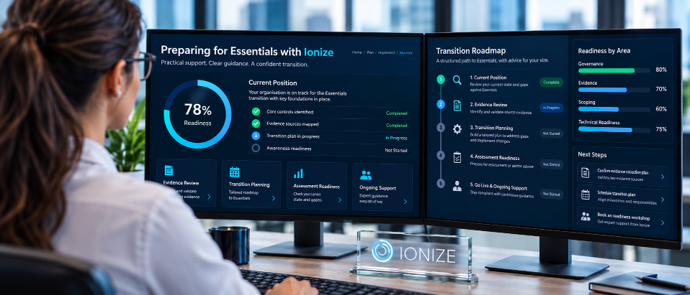
Ionize has been actively preparing for this change. Our Governance, Risk and Compliance team has been evaluating transition approaches and developing the assessment methodologies, evidence requirements and reporting processes needed to support customers.
With ASD’s detailed guidance now available, we are aligning this work with the published framework to help organisations understand their current position, identify gaps and develop practical transition roadmaps.
Our focus remains on helping customers make informed security decisions, preserve their existing investments and achieve stronger cyber resilience.
Essential Eight to Essentials: Building on What You Have Already Achieved
The Australian Signals Directorate (ASD) has today released its new Essentials guidance, marking a significant evolution in how Australian organisations approach cyber security.
At Ionize, we recognise both the need for this change and the direction ASD is taking. Cyber threats continue to evolve, technology environments are becoming increasingly complex, and the way organisations demonstrate cyber security effectiveness needs to evolve with them.
The Essential Eight has served Australian organisations well. It has provided a practical, recognisable benchmark for cyber security, helped organisations prioritise investment and given executives a clearer understanding of their security posture.
That investment remains valuable.
The introduction of Essentials is not about starting again. It is about building on those foundations and taking a broader view of how effectively organisations manage cyber risk.
What does this mean for organisations?
One of the more significant changes is the move toward assessing security outcomes rather than simply confirming that prescribed controls have been implemented.
It is no longer sufficient to ask whether a security control exists. Organisations increasingly need to demonstrate that their controls are operating effectively, are appropriate for their environment and continue to address the risks they face.
The new Essentials series also recognises that cyber security extends beyond traditional enterprise IT, with dedicated guidance for cloud and operational technology environments.
For organisations that have already invested in achieving Essential Eight Maturity Level 1, 2 or 3, the immediate priority should be understanding how those investments carry forward.
Existing maturity ratings will not automatically translate into an equivalent position under Essentials. However, established security controls, previous assessments and supporting evidence will provide a valuable starting point.
Preparing for the transition
Organisations should take a considered approach rather than immediately launching another comprehensive assessment or uplift program.
A sensible starting point is to review the current Essential Eight position, identify which controls and evidence remain relevant, understand where additional assurance may be required, and establish a practical transition roadmap.
This is particularly important for organisations that have recently completed an Essential Eight assessment. There is considerable value in preserving that investment while identifying what additional work may be necessary.
How Ionize is preparing
At Ionize, we have been actively evaluating the evolution of Essential Eight and its implications for both our customers and our cyber security assessment services.
Our Governance, Risk and Compliance team has been developing transition planning approaches that build on our existing Essential Eight assessment experience.
With ASD’s detailed guidance now available, we are aligning our assessment methodology, scoping processes, evidence requirements, and reporting approaches with the published framework.
Our focus is on helping customers understand what the changes mean for their organisation, to preserve existing security investments, and to establish a clear, achievable pathway toward the Essentials. Through our broader cyber security capability, spanning governance and risk, security engineering, technical testing and security operations, Ionize is well positioned to support organisations as they navigate this change.
The opportunity ahead
For boards and executives, the Essentials provides an opportunity to move the conversation beyond achieving a maturity rating toward understanding how effectively security investments are protecting the organisation.
For cyber security practitioners, it provides an opportunity to strengthen the relationship between risk management, technical controls, and evidence of their effectiveness.
The transition will take planning, but it does not need to mean starting from scratch.
The organisations best prepared for Essentials will be those that use their existing Essential Eight investment as a foundation for stronger, more sustainable cyber security assurance.
At Ionize, we look forward to supporting our customers through that transition.
ASD’s newly released guidance can be found here: https://www.cyber.gov.au/publication/essentials-reading-guide